



1. Description for U type MoSi2 heating elements
Hongyuan's U-shaped molybdenum disilicide heating elements are manufactured through advanced sintering technology using premium-grade MoSi₂ material, achieving density parameters of 5.5-6.2 g/cm³. These elements withstand operational temperatures reaching 1850°C and feature asymmetrical design with terminal sections measuring twice the diameter of radiant heating zones. Integrated assembly with specialized welding and aluminum-plated connectors ensures optimal electrical conductivity. Designed for overhead mounting systems, they provide exceptional oxidation stability and thermal performance for advanced thermal processing in technical ceramics, electronic manufacturing, and energy material production sectors.
2. Parameters for U type MoSi2 heating elements
Physical property:
|
Volume density |
Bend strength |
Vickers hardness |
Porosity rate |
Water absorption rate |
Hot extensibility |
|
5.5~5.6kg/cm³ |
15~25kg/cm³ |
(HV)570kg/mm³ |
7.4% |
1.2% |
4% |
The Max temperature of elements in different atmospheres:
|
Atmosphere |
Max element temperature |
|
|
Hongyuan Super Ms17 |
Hongyuan Super Ms18 |
|
|
Air |
1700℃ |
1800℃ |
|
Nitrogen |
1600℃ |
1700℃ |
|
Argon, Helium |
1600℃ |
1700℃ |
|
Hydrogen |
1100℃~1450℃ |
1100℃~1450℃ |
|
N2/H2 95/5% |
1250℃~1600℃ |
1250℃~1600℃ |
|
General applications |
Most types of industrail furnace for heat treatment, forgoing, sintering, glass melting and refining and for use in radiant tubes. |
Laboratory furnaces, testing equipment and high temperature sintering production furnace. |
MoSi2 Heating Element Resistance versus Time:

3. Ordering information for U type MoSi2 heating elements
When ordering U-Type MoSi2 heating elements, please provide the following parameters:
|
Material Grade |
Diameter |
Hot zone length |
Cold end length |
Center distance |
|
1700, 1800 |
D1/D2, mm/mm |
Le, mm |
Lu, mm |
A, mm |
For example:
U-shaped shape, material grade 1800
D1=3mm, D2=6mm, Le=140mm, Lu=125mm, A=25mm
Represented as Specify as:
Hongyuan Super MS18, U-shaped, 3/6 × 140 × 125 × 25

Additional Options & Customization: Please inquire regarding specialized configurations or tailored engineering solutions. Our technical team supports custom parameter development for unique application requirements.
4. Detail Drawings for U type MoSi2 heating elements

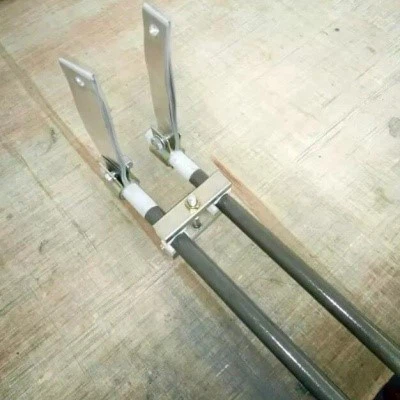
5. Connection Method for U type MoSi2 heating elements
◆ Electrical Interface Configuration: Terminal contacts are plated with aluminum to minimize electrical resistance and enhance current transfer efficiency.
◆ Connection Methodology: Utilize planar aluminum conductors with spring-loaded fasteners for secure junctions, compatible with 220-480V systems. Implement silicon-controlled rectifier regulation for precision thermal management.
Note: Maintain connector-cold end interfacial voltage below 0.01V. Select material grades (1700/1800/1850 series) according to specific atmospheric conditions and thermal requirements.
6. Application for U type MoSi2 heating elements
These elements serve critical functions across multiple thermal processing sectors:
◆ Advanced Thermal Processing: Essential for technical ceramic formation and specialized glass production under extreme temperatures.
◆ Electronic Device Fabrication: Deployed in silicon wafer thermal treatment and semiconductor diffusion systems for microelectronics manufacturing.
◆ Energy Material Production: Enables thermal processing of advanced battery components including electrode formulations.
◆ Specialized Material Synthesis: Maintains temperature uniformity for luminescent material preparation and precision metal casting operations.
◆ Research & Development: Supports experimental protocols and material characterization in scientific laboratory environments.
7. Advantages for U type MoSi2 heating elements
◆ Exceptional Thermal Endurance: Capable of sustained operation at 1850°C, engineered for extreme thermal environments.
◆ Superior Oxidation Stability: High-density molybdenum disilicide composition (5.5-6.2 g/cm³) ensures exceptional oxidation resistance and extended service life.
◆ Rapid Thermal Response: 4% thermal expansion coefficient enables uniform temperature distribution and fast heating cycles.
◆ Enhanced Chemical Durability: Minimal porosity (7.4%) and water absorption (0.2%) ensure reliable performance across multiple atmospheres including air and inert gases.
◆ Versatile Mounting Configuration: U-shaped geometry facilitates suspension installation with aluminum-plated terminals for simplified electrical integration.
◆ Consistent Electrical Properties: Stable electrical characteristics permit simultaneous operation of aged and new components.
◆ Global Delivery Service: 500-ton annual manufacturing output with 7-14 day delivery cycle.
8. Installation for U type MoSi2 heating elements
Installation and Maintenance Protocol for U-Type Molybdenum Disilicide Heating Elements:
◆ Pre-Installation Verification: Conduct visual inspection to confirm structural integrity, ensuring absence of surface defects or microfractures.
◆ Orientation Configuration: Position thermal radiation section (Le) vertically downward in suspended arrangements. Fully insert terminal sections (Lu) into furnace structure, ensuring complete encapsulation of transition zones to prevent thermal degradation.
◆ Radiation Spacing Parameters: Maintain minimum clearance equivalent to 3x heating section diameter from refractory surfaces to facilitate optimal heat dissipation.
◆ Mounting Methodology: Secure terminal sections using specialized ceramic or high-temperature alloy brackets to minimize mechanical strain.
◆ Electrical Interface Connection: Establish power linkage through planar aluminum conductors with spring-assisted fasteners, guaranteeing stable electrical contact.
◆ Initial Thermal Conditioning: Implement progressive power augmentation during commissioning to prevent thermal stress accumulation.
◆ Preventive Maintenance Schedule: Periodically examine electrical interfaces and retention hardware for connection integrity. Retighten fasteners after initial 2-3 operational cycles to compensate for thermal expansion effects.
Replacement Procedure
1) Identify compromised component and prepare replacement unit
2) De-energize system, disassemble electrical connections
3) Remove existing element and clear installation channels
4) Mount new unit through top access, reestablish connections
5) Conduct graduated thermal cycling to verify operational stability
Professional Requirement: Certified technicians must execute all procedures. Comprehensive technical documentation available upon request.
9. Design Suggestions for U type MoSi2 heating elements
◆ Dimensional Configuration: Ensure Lu (150-1000mm) and Le (150-1500mm) measurements correspond precisely to chamber geometry, preventing thermal section intrusion into insulation layers.
◆ Mounting Architecture: Select shank separation distance according to element diameter using standardized spacing parameters to ensure mechanical stability and thermal uniformity.
◆ Operational Environment: Specify 1700/1800/1850-grade elements according to process atmosphere requirements, consulting temperature rating tables for gas-specific limitations.
◆ Radiation Clearance: Maintain minimum 3x heated zone diameter from furnace walls or processed materials, with 4x diameter center-to-center spacing for optimal thermal transfer.
◆ Process Regulation: Implement proportional-integral-derivative control systems for accurate thermal management and enhanced operational longevity.
◆ Terminal Integrity: Verify preservation of aluminum-coated contact surfaces and secure electrical junctions to prevent connection resistance issues.
10. Customization Services for U type MoSi2 heating elements
HONGYUAN provides tailored solutions for U type molybdenum disilicide heating components:
Custom Engineering: Modify thermal/cooling zone dimensions, segment lengths, and connector spacing to match specific furnace requirements.
Material Grades: Available in 1700°C/1800°C/1850°C variants optimized for diverse atmospheric conditions and thermal thresholds.
Surface Enhancement: Apply specialized anti-oxidation treatments for improved durability in corrosive operational environments.
Production Flexibility: Accept original equipment manufacturing projects with volume production, and 7-14 day fulfillment cycles.
Technical Collaboration: Deliver engineering consultation supported by computational thermal analysis for system optimization.
HONGYUAN specializes in advanced MoSi2 heating systems for global industrial applications, enhancing performance in technical ceramics, electronics manufacturing, energy storage materials, and thermal processing. Contact our engineering team for product specifications, custom design services, or evaluation samples to upgrade your thermal processing capabilities.
11. FAQ for U type MoSi2 heating elements
Q: What is the maximum operating temperature of MoSi2 heating elements?
A: Standard elements operate at 1700-1800°C in air, with premium grades reaching 1850°C. Maximum temperature varies based on element diameter and atmospheric conditions.
Q: Why do MoSi2 elements form protective surface glaze during operation?
A: The formed silica layer acts as self-healing oxidation barrier. This glassy coating is essential for preventing continuous oxidation at high temperatures.
Q: How should broken MoSi2 elements be handled?
A: Disconnect power immediately. Use personal protective equipment when handling fractured elements. The material is non-toxic but sharp fragments require careful disposal.
Q: What causes rapid resistance increase in MoSi2 elements?
A: Typically indicates silica layer damage from thermal shock or chemical corrosion. In compatible atmospheres, the protective layer usually regenerates during subsequent heating cycles.
Q: Can MoSi2 elements operate in hydrogen atmospheres?
A: Not recommended. Hydrogen penetrates the protective silica layer at high temperatures, causing accelerated degradation and premature failure.
Q: What's the proper installation orientation for U-type elements?
A: Both vertical and horizontal installations are acceptable. Ensure adequate support spacing (typically 150-200mm) to prevent sagging at operating temperatures.
Q: How long do MoSi2 elements typically last?
A: Service life ranges 6-24 months depending on operational cycles and atmosphere. Elements operating continuously at 1700°C typically maintain stable performance for 12+ months.
Hot Tags: molybdenum disilicide heating rod, China molybdenum disilicide heating rod manufacturers, factory, technician silicon molybdenum rod, developer silicon molybdenum rod, straight silicon molybdenum rod, molybdenum silicon rod, superior silicon molybdenum rod, verified silicon molybdenum rod


