

Company Profile
The company's production area covers an area of 40000 square meters and consists of eight workshops according to production processes, including crushing workshop, batching workshop, molding workshop, bonding workshop, drying workshop, resistance adjustment workshop, finished product workshop, and maintenance workshop.
We have large-scale equipment such as mixers, crushers, hydraulic presses, sintering furnaces, cutting machines, forming machines, docking machines, and various testing and inspection equipment. These hardware facilities provide guarantees for the company's automation and large-scale production.
For many years, the company has been committed to the research and development of high-temperature heating material technology and related fields, continuously improving product quality, accumulating rich manufacturing experience, possessing strong technical strength, advanced process equipment, complete quality assurance system and scientific management mode, providing high-quality products and perfect services for domestic and foreign customers.
Why Choose Us
Our factory
The company's production area covers an area of 40000 square meters and consists of eight workshops according to production processes, including crushing workshop, batching workshop, molding workshop, bonding workshop, drying workshop, resistance adjustment workshop, finished product workshop, and maintenance workshop.
Production equipment
We have large-scale equipment such as mixers, crushers, hydraulic presses, sintering furnaces, cutting machines, forming machines, docking machines, and various testing and inspection equipment. These hardware facilities provide guarantees for the company's automation and large-scale production.
Rich manufacturing experience
For many years, the company has been committed to the research and development of high-temperature heating material technology and related fields, continuously improving product quality, accumulating rich manufacturing experience, possessing strong technical strength, advanced process equipment, complete quality assurance system and scientific management mode, providing high-quality products and perfect services for domestic and foreign customers.
Production market
The products are exported to various parts of the country and exported to more than ten countries and regions such as South Korea, Japan, Thailand, India, etc., and are deeply trusted by customers. At present, the company's various products have passed ISO9001 international quality system certification.

Silicon carbide roller is a cylindrical rod-shaped product made of silicon carbide material, mainly used in production lines of industrial kilns, high-temperature furnaces, glass, ceramics and other industries, playing the role of carrying, conducting heat and supporting materials.

Silicon carbide roller has high wear resistance, silicon carbide rollers can maintain stable performance for a long time, reduce replacement frequency, and lower production costs.
What Is Silicon Carbide Roller
Silicon carbide roller is an important industrial material, mainly made of silicon carbide, with high hardness, strength, wear resistance, and corrosion resistance. It is widely used in various fields such as ceramics, glass, metallurgy, and chemical engineering. Specifically, in the manufacturing process of ceramics and glass, silicon carbide rollers can withstand high temperature and high pressure environments, ensuring smooth production.
Meanwhile, due to its high wear resistance, silicon carbide rollers can maintain stable performance for a long time, reduce replacement frequency, and lower production costs. In addition, silicon carbide rollers also have good chemical stability, which can resist the erosion of corrosive substances such as acid and alkali, and extend their service life. These excellent properties make silicon carbide rollers an indispensable key component in the industrial field.
Advantages of Silicon Carbide Roller
High temperature resistance
Silicon carbide rollers can withstand extremely high temperatures, making them ideal for use in industries like glass manufacturing, ceramics, and semiconductor production. The maximum service temperature of silicon carbide can reach up to 970 k (1286.33 °f).
Excellent thermal conductivity
Silicon carbide's thermal conductivity ranges from 3.8 to 20.7 w/m.K. This high thermal conductivity allows these rollers to quickly dissipinate heat, reducing the risk of thermal damage and ensuring more uniform heating across the surface of the material being processed.
Superior wear resistance
Silicon carbide is highly resistant to wear and tear, which is a critical attribute in industries where rollers are subject to constant use and high mechanical stress. This wear resistance contributes to the long service life of silicon carbide rollers, which can result in cost savings over time.
High hardness
The hardness of silicon carbide ranges from 600 to 3800 mpa, which is much higher than most metals. This hardness contributes to the wear resistance and durability of silicon carbide rollers.
Dimensional stability
Silicon carbide rollers exhibit superior dimensional stability, maintaining their shape and size even under high temperatures and pressures. This ensures consistent performance and quality in manufacturing processes.
Low thermal expansion
Silicon carbide has a relatively low coefficient of thermal expansion (7.9-11 10^-6/k), meaning it doesn't expand or contract much with temperature changes. This stability is crucial in high-temperature applications and helps to maintain the integrity of the roller and the materials being processed.
Introduction to the Basics of Silicon Carbide Rollers
The minimum standard for straightness of rollers is <=0.8‰. Each roller straightness needs to be laser tested before leaving the factory, and the test data will be provided to customers. Each roller needs to be tested by a 70Mpa standard bending strength testing machine to ensure the reliability of each roller.
Silicon carbide rollers can provide technically superior and cost-effective solutions in harsh high-temperature furnace applications. Compared with traditional reaction sintered silicon carbide (SiSiC), recrystallized silicon carbide (R-SiC) and nitride bonded silicon carbide (N-SiC), they can bear higher loads at higher temperature for longer period of time, Therefore, the productivity of the unit furnace can be increased.
The excellent chemical resistance of silicon carbide rollers allows it to work for a long time in strong corrosive atmospheres and ionic environments, and has a longer life. The strong oxidation resistance of silicon carbide rollers allows it to work stably for a long time even in an oxidizing atmosphere, and has a longer life.
In some applications, even if the user only chooses silicon carbide rollers in the high temperature zone, as the size of the rollers is reduced, the size of the corresponding kiln bearings and other accessories is smaller to reduce the cost, and in the low temperature zone, the same size SiSiC rollers or heat-resistant alloys can be used therefore save a lot of costs for users.
Silicon carbide rollers, also known as SISIC rollers, are widely used in various industries due to their exceptional properties. These rollers are made from silicon carbide ceramic, a material known for its high strength, excellent thermal conductivity, and resistance to wear and corrosion. Let's explore the various uses of silicon carbide rollers in different applications.
Roller kilns in the ceramic industry
Silicon carbide rollers are extensively used in roller kilns for firing ceramic products. These rollers can withstand high temperatures and provide excellent thermal shock resistance. They ensure smooth and continuous movement of ceramic products through the kiln, resulting in uniform heat distribution and consistent firing.
Glass manufacturing
Silicon carbide rollers find applications in glass manufacturing processes. They are used in glass tempering furnaces, annealing lehrs, and other heating equipment. The rollers' high temperature resistance and low thermal expansion coefficient make them ideal for these applications, ensuring precise and controlled glass processing.
Metal heat treatment
Silicon carbide rollers are also used in metal heat treatment processes such as annealing, quenching, and sintering. These rollers can withstand extreme temperatures and provide excellent dimensional stability. They ensure uniform heating and cooling of metal parts, resulting in improved mechanical properties and reduced distortion.
Semiconductor industry
Silicon carbide rollers are employed in the semiconductor industry for various applications. They are used in diffusion furnaces, oxidation furnaces, and other high-temperature processes. The rollers' high purity and chemical inertness make them suitable for handling semiconductor wafers without contaminating them.
Other industrial applications
Silicon carbide rollers find use in several other industrial applications. They are utilized in roller hearth furnaces, powder metallurgy processes, and kilns for the production of advanced ceramics. The rollers' exceptional mechanical properties and resistance to chemical attack enable them to withstand harsh operating conditions in these applications.
Silicon carbide rollers have diverse uses across multiple industries. Their exceptional properties, including high strength, thermal conductivity, and resistance to wear and corrosion, make them suitable for various applications. From ceramic and glass manufacturing to metal heat treatment and semiconductor processes, these rollers play a crucial role in ensuring efficient and precise operations. The continued development and utilization of silicon carbide rollers contribute to advancements in different industries.
Manufacturing Process of Silicon Carbide Rollers
The production of SiC rollers typically involves three main steps:

Powder Production
The process begins with the production of high-purity silicon carbide powder, which is often a combination of silicon and carbon precursors. These precursors undergo a series of chemical reactions to form fine SiC particles.

Shaping
The SiC powder is then mixed with binders and pressed into the desired shape using various techniques, such as dry pressing or isostatic pressing. This forms a green body, which is a compacted, unsintered product.

Sintering
The green body is heated to high temperatures in a controlled atmosphere, allowing the SiC particles to bond together and form a dense, strong structure. This process, known as sintering, results in the final silicon carbide roller.
How to Store Silicon Carbide Roller
Silicon carbide roller as an important raw material for production, many customers in the purchase of silicon carbide roller when the price of silicon carbide roller will be low when a large number of stocks, in order to use, such an approach is better, not only to reduce production costs can also avoid market risks, but after the purchase of a large number of silicon carbide roller, silicon carbide roller storage is very important, although silicon carbide roller does not have a shelf life can be stored for a long time, but if the storage method is not appropriate, it the quality of silicon carbide roller will be affected if stored improperly.
Orderly storage, the same batch number as far as possible in rows, to avoid mistakes in the process of taking materials. Silicon carbide roller micro powder has a strong moisture absorption, try to avoid removing the moisture-proof film storage; this can avoid moisture agglomeration, shorten the drying time.
As far as possible to use the principle of first-in first-out material, to avoid clumping of raw materials due to excessive storage time. If the ultra-fine silicon carbide roller powder in transit broken packaging, try to store separately to avoid dust pollution. It is recommended that the warehouse as far as possible closed, stored separately, and pay attention to moisture, wind and rain.
What Should We Pay Attention to When Installing and Replacing Silicon Carbide Roller
Silicon carbide rollers have the advantages of small high-temperature deformation, fast heating, etc. And as electric heating elements, silicon carbide rollers are easier to install and maintain than others, which are convenient, safe and reliable.
Silicon carbide rollers are widely used in high-temperature fields such as electronics, magnetic materials, powder metallurgy, ceramics, glass, semiconductors, analytical testing, scientific research, etc., and have become electric heating elements for tunnel kilns, roller kilns, glass kilns, vacuum furnaces, muffle furnaces, smelting furnaces and various heating equipment.
The installation and maintenance of silicon carbide rollers are relatively convenient, but there are also some operations that need to be paid attention to during the installation and use process: When installing silicon carbide rollers, both ends should be covered with sleeves made of insulation cotton to separate the silicon carbide rollers and the electrode bricks, otherwise the silicon carbide rollers and the electrode bricks will be stuck by the glass volatiles.
The heat resistance temperature of the sleeve must adapt to the temperature of the feeding channel. If the heat resistance temperature is too low, the sleeve will melt and corrode the silicon carbide roller after melting, and it will also stick the rod, making it difficult to replace the silicon carbide roller.
The rod hole must be aligned correctly to ensure that the rod can rotate 360° freely after installation, and the rod must not be jammed.
A certain safety distance must be ensured between the silicon carbide roller and the channel cover plate and the material liquid level. The rod is too close to the cover plate will cause local overheating of both; the rod is too close to the material liquid level, which will increase the corrosion of the glass volatiles on the rod. The rod may deform and bend and easily contact with the liquid level, causing the glass liquid to be electrified.
In principle, the silicon carbide rollers should be replaced as a whole group to avoid mixing new and old rods. However, in practice, most manufacturers are reluctant to do so. It is troublesome and wasteful. A more feasible method is to pull out the broken rod under the premise that the temperature can be guaranteed. Plug the rod hole without installing a new rod. When a broken rod occurs next time, do the same.
When the temperature does not meet the requirements, pull out all remaining rods in the group and replace them with a new group of rods. If the transformer has been adjusted to high voltage gear , it should be adjusted back to the lowest gear before sending electricity for heating. Save the unbroken silicon carbide rollers that are removed and use them together with old rods next time (of course, it is best to measure each rod's voltage , current , calculate each rod's resistance before removing it , mark it on one end of each rod , so that they can be grouped according to resistance values).
The company's production area covers an area of 40000 square meters and consists of eight workshops according to production processes, including crushing workshop, batching workshop, molding workshop, bonding workshop, drying workshop, resistance adjustment workshop, finished product workshop, and maintenance workshop. We have large-scale equipment such as mixers, crushers, hydraulic presses, sintering furnaces, cutting machines, forming machines, docking machines, and various testing and inspection equipment.
These hardware facilities provide guarantees for the company's automation and large-scale production. For many years, the company has been committed to the research and development of high-temperature heating material technology and related fields, continuously improving product quality, accumulating rich manufacturing experience, possessing strong technical strength, advanced process equipment, complete quality assurance system and scientific management mode, providing high-quality products and perfect services for domestic and foreign customers.
The products are exported to various parts of the country and exported to more than ten countries and regions such as South Korea, Japan, Thailand, India, etc., and are deeply trusted by customers. At present, the company's various products have passed ISO9001 international quality system certification.


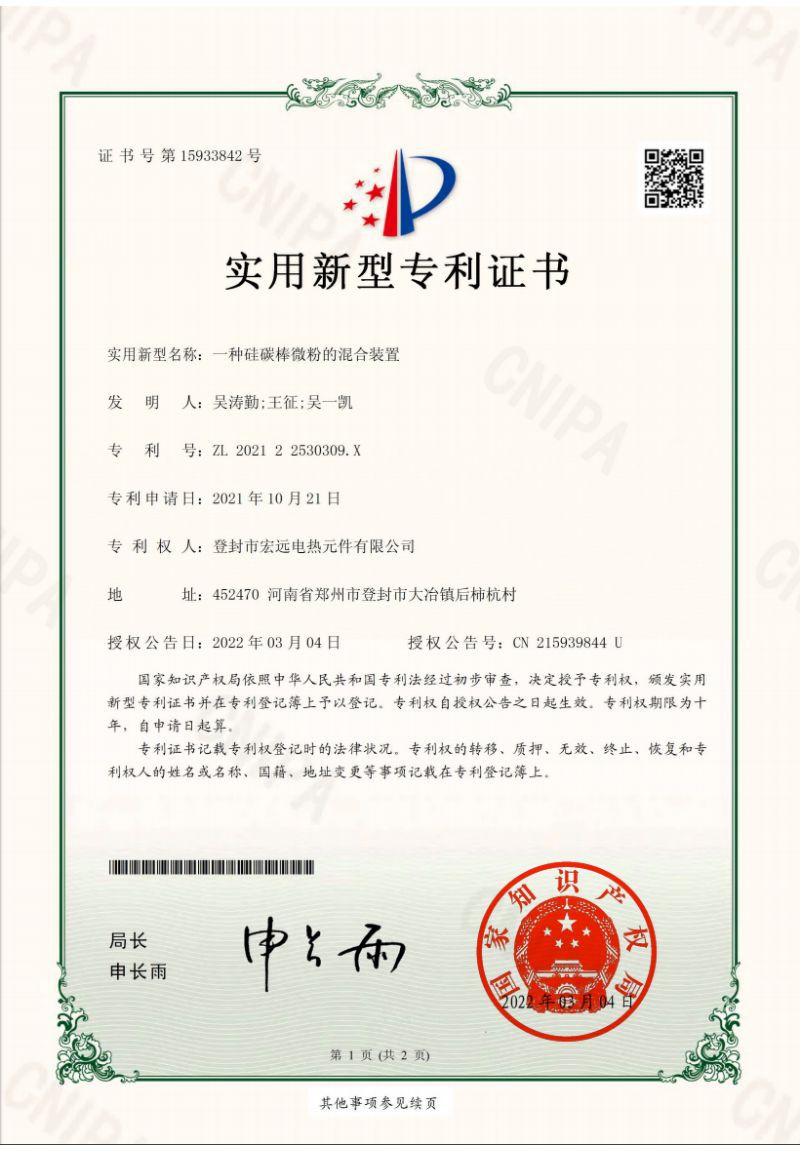
Certificates


FAQ
Hot Tags: silicon carbide roller, China silicon carbide roller manufacturers, factory, electronic silicon carbide, spectroscopy with silicon carbide, piping with silicon carbide, weighing with silicon carbide, silicon carbide for inspection, silicon carbide for catalysts


