Abstract
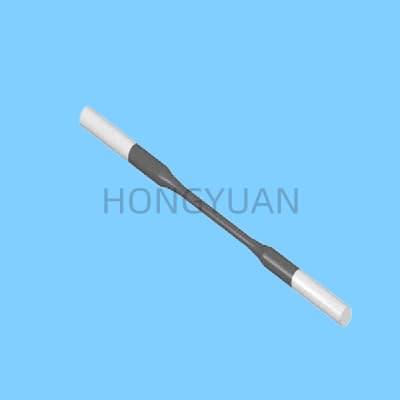
Silicon carbide (SiC) heating elements are widely used in high-temperature industrial furnaces, laboratory furnaces, heat treatment systems, and semiconductor processing equipment. Unlike metallic heating materials, SiC exhibits semiconductor electrical behavior, resulting in a nonlinear resistance–temperature (R–T) relationship. Understanding this characteristic is essential for furnace design, power supply matching, temperature control, and lifetime prediction of SiC heating elements.
1. Electrical Conduction Mechanism of SiC
Silicon carbide is a typical wide-bandgap semiconductor material. At room temperature, the concentration of free carriers in SiC is relatively low, leading to high electrical resistivity. As temperature increases, thermal excitation generates more charge carriers, improving electrical conductivity.
Commercial SiC heating elements are generally manufactured by:
high-purity SiC powder preparation;
extrusion forming;
high-temperature sintering;
surface coating or recrystallization treatment.
Electrical conduction is mainly influenced by:
electron and hole excitation;
impurity-related carriers;
grain boundaries and defect structures.
Therefore, the resistance of SiC elements depends not only on temperature but also on microstructure and manufacturing conditions.
2. R–T Behavior of SiC Heating Elements
SiC heating elements exhibit a typical negative temperature coefficient (NTC) behavior:
Resistance decreases as temperature increases.
At low temperatures, SiC has relatively high resistance. During heating, carrier concentration increases rapidly, causing resistance to drop significantly. At elevated temperatures, the resistance change becomes slower and reaches a relatively stable region.
Typical characteristics:
| Temperature Range | Resistance Behavior |
|---|---|
| Room temperature–600℃ | Rapid resistance decrease |
| 600–1200℃ | Continuous but slower decrease |
| 1200–1600℃ | Stable operating region |
| Above 1600℃ | Increased aging and resistance drift |
The R–T relationship can be approximately described by semiconductor activation behavior:
RT=R0ekTEa
where:
RT is the resistance at temperature T;
R0 is a material constant;
Ea is activation energy;
k is Boltzmann constant;
T is absolute temperature.
3. Effect of Operating Temperature
Low Temperature Region
At low temperatures, carrier concentration is limited and resistance remains high. During startup, SiC elements require higher voltage to achieve sufficient current flow.
Therefore, industrial SiC furnaces often use:
voltage regulation systems;
soft-start control;
current limiting protection.
High Temperature Region
During high-temperature operation, resistance decreases significantly and current increases. Under constant voltage operation, excessive power may occur, causing:
overheating;
accelerated aging;
local thermal stress.
Therefore, industrial systems commonly use:
transformer control;
SCR power regulation;
PID temperature control.
4. Aging Effects on Resistance Characteristics
Long-term operation causes oxidation and microstructural changes, resulting in gradual resistance increase.
Oxidation
In an oxygen atmosphere:
SiC+2O2→SiO2+CO2
A protective SiO₂ layer forms on the surface, but the effective conductive area decreases gradually.
Microstructural Evolution
High-temperature aging may cause:
grain growth;
changes in grain boundaries;
reduction of conductive paths.
The typical results are:
increased cold resistance;
increased operating resistance;
reduced maximum service temperature.
5. Comparison Between SiC and Metallic Heating Elements
| Property | SiC Heating Element | Metallic Heating Wire |
|---|---|---|
| Electrical behavior | Semiconductor | Metallic conductor |
| Temperature coefficient | Negative | Positive |
| High-temperature stability | Excellent | Moderate |
| Maximum temperature | 1200–1600℃ | 800–1200℃ |
| Oxidation resistance | Good | Limited |
| Service life | Long | Shorter |
6. Industrial Importance
A proper understanding of SiC resistance–temperature characteristics enables:
optimized furnace startup control;
improved energy efficiency;
reduced electrical shock during operation;
longer heating element lifetime;
improved temperature accuracy.
Modern high-temperature furnaces often monitor resistance variation to evaluate element aging and perform predictive maintenance.
Conclusion
SiC heating elements possess unique semiconductor electrical characteristics, showing a nonlinear resistance–temperature relationship with decreasing resistance at higher temperatures. This behavior requires appropriate electrical control strategies in industrial furnace systems. Through optimized material design, manufacturing processes, and operation control, SiC heating elements can achieve higher stability, longer service life, and improved energy efficiency, making them one of the most important heating materials for modern high-temperature applications.