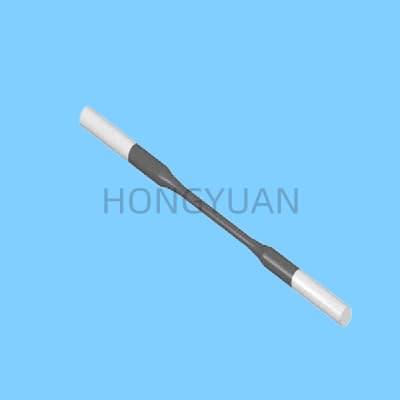
Main Raw Materials of Silicon Carbide Heating Elements
The performance of SiC heating elements is strongly influenced by raw material purity, particle distribution, crystal structure, and formulation control.
1. Silicon Carbide (SiC)
Silicon carbide is the primary raw material and usually accounts for more than 80% of the composition.
Common types include:
Green Silicon Carbide
Features:
Higher purity;
Better crystal structure;
More stable electrical resistance;
Suitable for demanding high-temperature applications.
Black Silicon Carbide
Features:
Higher mechanical strength;
Lower production cost;
Widely used in conventional industrial furnaces.
Silicon carbide provides:
Electrical conductivity;
High-temperature strength;
Thermal conductivity;
Thermal shock resistance.
2. Carbon Materials
Carbon-based materials are added to adjust electrical resistance and improve sintering performance.
Typical carbon sources include:
Graphite powder;
Carbon black;
Petroleum coke;
Anthracite powder.
Carbon materials help create stable conductive networks between silicon carbide particles.
3. Binders
Since silicon carbide particles are difficult to form directly, binders are required during manufacturing.
Common binders include:
Dextrin;
Phenolic resin;
Coal tar;
Organic resin;
Silica sol.
Their functions include:
Improving green strength;
Enhancing particle bonding;
Supporting the sintering process.
4. Functional Additives
Small amounts of additives may be introduced to improve product performance:
Silicon powder;
Aluminum oxide;
Silicon nitride;
Rare earth oxides.
These additives improve:
Oxidation resistance;
Mechanical strength;
Electrical stability;
Service life.
Manufacturing Process of Silicon Carbide Heating Elements
The manufacturing process includes several critical stages:
Raw Material Preparation → Mixing → Extrusion Forming → Drying → High-temperature Sintering → Machining → Inspection → Packaging
1. Raw Material Preparation
Silicon carbide powders are processed through:
Crushing;
Magnetic separation;
Screening;
Particle classification.
Proper particle size distribution helps achieve:
Uniform electrical resistance;
Suitable porosity;
Improved mechanical strength.
2. Mixing and Formulation
Raw materials are accurately weighed and mixed according to product requirements.
The mixture usually contains:
Silicon carbide;
Carbon materials;
Additives;
Binders.
A uniform mixture is essential for stable product performance.
3. Extrusion Forming
Extrusion is the most common forming method.
After vacuum kneading, the material is extruded into different shapes:
Straight rods;
U-shaped elements;
Threaded designs;
Customized structures.
Forming quality directly affects:
Dimensional accuracy;
Resistance uniformity;
Service life.
4. Drying Process
The formed green bodies are slowly dried to remove moisture and reduce internal stress.
Proper drying prevents:
Cracking;
Deformation;
Structural defects.
5. High-temperature Sintering
Sintering is the most critical manufacturing stage.
Industrial production usually uses:
Resistance furnace sintering;
Electrically heated sintering processes.
Sintering temperatures are generally above 2000°C.
During sintering:
Silicon carbide particles bond together;
Crystal grains grow;
A stable structure is formed;
Electrical properties become stable.
Sintering quality determines:
Maximum operating temperature;
Resistance stability;
Oxidation resistance;
Service lifetime.
6. Machining and Quality Inspection
After sintering, SiC heating elements undergo precision machining:
Diameter grinding;
Cold-end processing;
Thread machining;
Terminal finishing.
Quality inspection includes:
Electrical Tests
Resistance measurement;
Resistance uniformity;
Power stability.
Physical Tests
Density;
Mechanical strength;
Porosity.
High-temperature Tests
Thermal shock resistance;
Oxidation resistance;
Long-term operation stability.
Key Factors Affecting Product Quality
Raw Material Purity
Higher purity silicon carbide improves:
Thermal stability;
Oxidation resistance;
Operating lifetime.
Material Formulation
Different industries require different formulations:
Glass industry: excellent oxidation resistance;
Ceramic industry: thermal stability;
Semiconductor industry: high purity and low contamination.
Sintering Technology
Advanced sintering technology improves:
Grain bonding;
Electrical consistency;
Product reliability.
Future Development Trends
The silicon carbide heating element industry is moving toward:
1. Higher Purity
Meeting the requirements of semiconductor and new energy industries.
2. Longer Service Life
Improving oxidation resistance through advanced material design.
3. Energy Efficiency
Reducing resistance drift and improving thermal efficiency.
4. Customized Solutions
Developing heating elements for specific furnace designs and applications.
Conclusion
Silicon carbide heating elements combine excellent electrical, thermal, and mechanical properties, making them indispensable components in modern high-temperature industries. Continuous improvements in raw materials, formulation technology, and manufacturing processes will further enhance their performance and expand their applications in advanced manufacturing, renewable energy, electronics, and semiconductor industries.