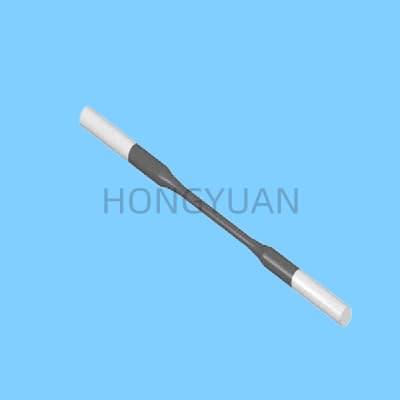
There is a nonlinear relationship between the resistance value of silicon carbide rods and temperature, which is mainly manifested in the variation of the resistivity of silicon carbide rods with temperature, especially when reaching 800 degrees Celsius, the resistivity shows a turning point, and then gradually increases with the continued increase of temperature. This non-linear change in resistivity is an important characteristic of silicon carbide rods, which is crucial for their application and design.
The resistivity variation characteristics of silicon carbon rods
The resistivity of silicon carbide rods rapidly decreases with increasing temperature within the range of room temperature to 800 ° C. This is because within this temperature range, the resistivity of silicon carbide rods changes negatively, meaning that as the temperature increases, the resistivity decreases.
After exceeding 800 ° C, the resistivity begins to slowly increase. This is because outside of this temperature range, the resistivity of the silicon carbide rod changes to a positive value, meaning that as the temperature continues to rise, the resistivity increases.
Limitations and safety precautions for the use of silicon carbide rods
The maximum operating temperature of silicon carbide rods cannot exceed 1450 ° C. Beyond this temperature, the silicon carbide rod will rapidly age and its service life will be severely affected.
During use, the resistance value of the silicon carbide rod will slowly increase. When its resistance value increases to four times the resistance value at the beginning of use, even if the silicon carbide rod is not powered off, its service life is considered to have ended.
Considerations in practical applications
When designing a system using silicon carbide rods, it is necessary to consider the temperature dependent characteristics of their resistivity and the resistance values at different temperatures to ensure the safety and efficiency of the system.
In order to ensure the effective operation and safety of silicon carbide rods, the length of the cold end should be equal to the thickness of the furnace wall plus the length of the cold end protruding from the furnace wall. The common extension length of the cold end is 50-150mm.
In summary, there is a nonlinear relationship between the resistance of silicon carbide rods and temperature, which is crucial for the application and design of silicon carbide rods. Understanding this relationship can help better utilize the characteristics of silicon carbide rods, ensuring the safety and efficiency of the system.