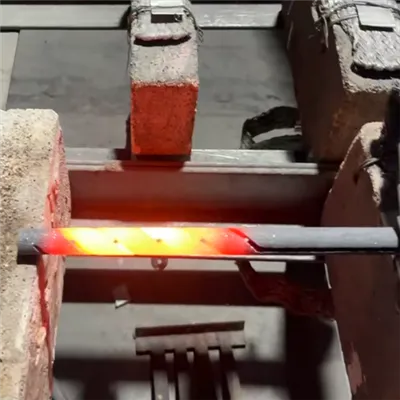
Silicon Carbide Rods are essentially consumables. Their service life is not fixed, but depends on the operating environment, working temperature and maintenance methods. In short, their lifespan varies from several days to several years. For general industrial applications, the common replacement cycle ranges from 3 months to 1 year. For your intuitive reference, here are the lifespan criteria and key influencing factors:
1. Lifespan Reference Standard
The end of service life does not usually mean burnout. Instead, it refers to a 4-time increase in initial resistance, which causes insufficient heating power and failure to maintain process temperature.
Ideal working conditions: Over 2,000 hours. Continuous operation, moderate temperature (<1300℃) and non-corrosive atmosphere.
Regular industrial conditions: 3 to 12 months. Normal wear in industries like magnetic materials and ceramic sintering.
Harsh working conditions: Several days to 1 month. Scenarios such as special glass smelting, strong corrosive volatiles (sulfur, alkali metals), and frequent rapid heating & cooling.
Intermittent furnaces: Greatly shortened service life, usually halved compared with continuous furnaces.
2. Four Core Factors That Shorten Service Life
If your rods wear out far faster than the standard, the main causes are as follows:
High temperature accelerates aging
At over 1000℃, a protective silica film forms on the rod surface through oxidation. Higher temperatures speed up oxidation and resistance growth.Avoid full-load operation at extreme temperatures (e.g. 1450℃) for long periods. The long-term working temperature is recommended to be 50-100℃ below the rated value.
Frequent temperature rise and fall
Easily overlooked, the protective film undergoes crystal transformation around 270℃ with drastic volume expansion and contraction.Intermittent furnaces repeatedly pass this temperature point, causing the film to crack and peel, and speeding up internal oxidation.
Atmospheric corrosion
Water vapor reacts with silicon carbide to produce hydrogen and worsen oxidation. Volatiles including alkali metals, sulfur, chlorine, fluorine and molten metals will corrode the rods and lead to rapid scrappage.
Excessive surface load density
Excessive current per unit area causes overheating. The recommended surface load density is 6~8 W/cm²; higher furnace temperatures require lower load density.
3. Replacement Judgment Signs
Replace rods in time before fracture occurs:
Excessive resistance: Resistance rises to 3-4 times the initial value of new rods.
Slow temperature rise: Longer heating time or failure to reach the set maximum temperature with constant voltage.
Abnormal appearance: Obvious cracks, peeling or blackening; partial non-heating after power-on.
4. Practical Tips to Prolong Service Life
Matching old and new rods: Never replace only damaged single rods. New rods with low resistance will be overloaded and burnt out when connected in series with old ones. Match resistance or replace the whole set.
Voltage regulation: Increase voltage via transformers to compensate power loss as resistance rises over time.
Slow temperature adjustment: Avoid rapid heating and cooling, especially lingering around 270℃; cool down with the furnace.
Summary
A service life of 6 months to 1 year is normal for silicon carbide rods; a lifespan of over two years indicates excellent furnace conditions and daily maintenance.