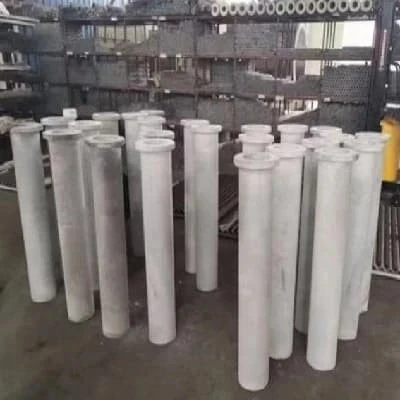
The length, diameter, and power of silicon carbide (SiC) heating elements are closely related. Proper matching of these parameters is essential for achieving the required furnace temperature, improving heating efficiency, and extending element service life.
1. Effect of Length on Power
A SiC heating element generally consists of a heating section and cold ends. The heating section is the part that generates heat. Under the same surface loading conditions, a longer heating section provides a larger heating surface area and can deliver higher power.
The heating surface area can be calculated as:
[
S=\pi DL
]
Where:
S = heating surface area
D = heating section diameter
L = heating section length
Therefore, when the diameter remains unchanged, increasing the heating length increases the effective heating area and allows higher heat output.
However, excessive heating length can increase resistance, affect voltage matching, and create installation limitations. Therefore, the heating length should be designed according to furnace dimensions.
2. Effect of Diameter on Power
The diameter of a SiC heating element affects both mechanical strength and power capacity.
Generally:
A larger diameter provides a larger cross-sectional area and higher current-carrying capability.
A larger diameter results in lower resistance per unit length.
Larger diameter elements usually have higher power capacity and better thermal shock resistance.
Therefore, large industrial furnaces and continuous high-power applications often use larger diameter SiC elements.
3. Relationship Between Length, Diameter, and Resistance
The resistance of a SiC heating element is related to its dimensions:
[
R=\rho\frac{L}{A}
]
Where:
R = electrical resistance
ρ = material resistivity
L = element length
A = cross-sectional area
The formula shows:
Increasing length increases resistance.
Increasing diameter increases cross-sectional area and reduces resistance.
Therefore, the length and diameter must be designed to achieve the required resistance under the available power supply conditions.
4. Power Calculation
SiC heating elements generate heat through electrical resistance. The power can be calculated as:
[
P=\frac{U^2}{R}
]
Where:
P = power output
U = operating voltage
R = resistance of the SiC element
After the element dimensions are determined, the resistance value directly affects the actual power output.
During selection, the following factors should be considered:
Power supply voltage;
Electrical connection method (series, parallel, star, or delta connection);
Required power per element;
Furnace temperature;
Heating zone size.
5. How to Achieve Proper Matching?
In practical applications:
For high-temperature and high-power furnaces:
Larger diameter SiC elements are preferred for better load capacity and reliability.
For limited furnace space:
The heating length should be optimized to achieve sufficient heating area.
For continuous operation:
The surface loading should be controlled to avoid excessive thermal stress.
For specific electrical systems:
The resistance should be matched according to supply voltage and control method.
Conclusion
The length, diameter, and power of SiC heating elements are not independent parameters but closely connected design factors. Length mainly affects heating area and resistance, diameter affects current capacity and durability, and power depends on the relationship between voltage and resistance.
Proper SiC heating element selection requires comprehensive consideration of furnace temperature, furnace design, electrical supply, resistance, surface loading, and operating environment to achieve stable heating performance and long service life.