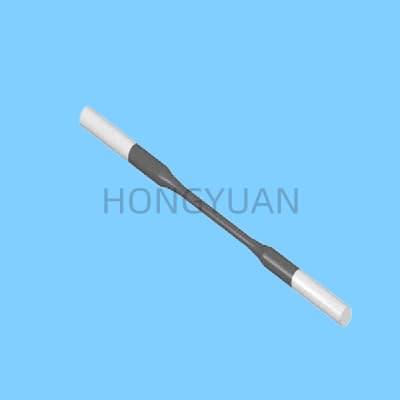
What Is a Silicon Carbide Heating Element?
A silicon carbide heating element is a non-metallic electric resistance heating element made mainly from silicon carbide material.
Unlike traditional metal heating elements such as resistance wires, SiC elements can operate at much higher temperatures while maintaining stable heating performance.
A typical SiC heating element consists of:
Hot zone – the central heating section that generates heat;
Cold ends – the low-resistance sections used for electrical connection;
Terminal connections – used to connect the element to the power supply.
Common SiC heating element designs include:
Straight type;
U-shaped type;
W-shaped type;
Customized shapes for special furnace designs.
How Does a Silicon Carbide Heating Element Work?
The working principle of a SiC heating element is based on electrical resistance heating.
When electric current passes through the silicon carbide material, the electrical resistance of the element converts electrical energy into heat energy.
The basic process is:
Electrical energy → Resistance heating → Heat radiation → Furnace heating
As the current flows through the hot zone, the element temperature increases and transfers heat to the furnace chamber through radiation and convection.
Because SiC materials have stable high-temperature properties, they can continuously generate heat in demanding industrial environments.
Why Is Silicon Carbide Used as a Heating Material?
Silicon carbide has several characteristics that make it suitable for high-temperature heating applications:
1. High Operating Temperature
SiC heating elements can work at temperatures much higher than conventional metal heating elements.
They are commonly used in furnaces operating at:
Ceramic sintering temperatures;
Electronic component processing temperatures;
Powder metallurgy temperatures;
Advanced material heat treatment temperatures.
2. Excellent Oxidation Resistance
When exposed to air at high temperatures, silicon carbide forms a protective silicon dioxide layer on the surface.
This protective layer helps slow down further oxidation and improves element durability.
3. Fast Heating Response
Compared with some traditional heating solutions, SiC elements have relatively low thermal mass, allowing efficient heating and temperature control.
4. Long Service Life
With proper furnace design, electrical control, and operating conditions, SiC heating elements can provide long-term stable operation.
Applications of SiC Heating Elements
Silicon carbide heating elements are widely used in industries such as:
Ceramic Industry
Used in ceramic kilns for:
Technical ceramics;
Ceramic tiles;
Sanitary ceramics;
Advanced ceramic materials.
Lithium Battery Materials
Used in high-temperature furnaces for:
Cathode material sintering;
Anode material processing;
Powder calcination.
Electronic Industry
Used for processing:
Semiconductor materials;
Electronic ceramics;
Magnetic materials.
Laboratory and Research Furnaces
Commonly used in:
Muffle furnaces;
Tube furnaces;
High-temperature testing equipment.
Factors Affecting SiC Heating Element Performance
Although SiC elements are designed for high-temperature applications, their performance depends on proper selection and operation.
Important factors include:
Furnace Temperature
Higher operating temperatures generally increase element aging speed.
Electrical Control
Proper voltage regulation and power control help maintain stable operation.
Furnace Atmosphere
Different atmospheres, including air, nitrogen, and reducing environments, can influence element life.
Installation Method
Correct installation spacing and mechanical support are important to prevent overheating and mechanical damage.
SiC Heating Element Resistance Aging
One important characteristic of silicon carbide heating elements is resistance aging.
During long-term operation, the electrical resistance of SiC elements gradually increases due to material changes and oxidation.
As resistance increases, the output power may decrease if the voltage remains unchanged.
Therefore, industrial furnaces using SiC heating elements usually require adjustable power control systems to compensate for resistance changes during service.
Conclusion
Silicon carbide heating elements are reliable high-temperature electric heating solutions widely used in industrial furnaces.
Their excellent temperature capability, oxidation resistance, and stable performance make them ideal for ceramic, battery material, electronic, and advanced material processing applications.
A successful SiC heating system requires not only selecting the correct element size but also considering furnace design, electrical control, installation method, and operating conditions.
For selecting suitable SiC heating elements, customers should provide information such as:
Furnace type;
Working temperature;
Furnace dimensions;
Power supply parameters;
Heating atmosphere;
Required element specifications.
With proper design and operation, SiC heating elements can provide efficient and stable heating performance for many high-temperature applications.